Balancing transport efficiency, economic profitability, and environmental impact has become an important challenge for on-road freight industry. Truck payload not only directly affects transport organization efficiency and fleet profitability, but also significantly influences vehicle energy consumption and CO2 emissions. Recently, Prof. Ye Wu’s group from the School of Environment evaluated the co-benefits of truck payload management on economic profitability and decarbonization using real-world truck weighing data and onboard monitoring (OBM) data. The study found substantial differences in payload levels across freight fleets with different operational purposes. Light-duty goods trucks exhibited an average loading factor as high as 178% (78% above the permitted payload), while the average loading factors of other fleets mainly ranged from 23% to 68%. The results further showed that every additional tonne of payload increased average fuel consumption by approximately 2%–7%, with light-duty trucks being more sensitive to payload variation. Moreover, the study demonstrated that integrated truck payload management strategies combining “maximum loading enforcement” and “empty-running optimization” could simultaneously improve economic profitability and reduce carbon emissions, providing new insights for the safe, efficient, and sustainable development of the road freight sector.
Road freight plays a vital role in supporting economic activity and supply chain operations, it is also a major contributor to carbon emissions in the transportation sector. In China, road freight accounts for only about one-third of total freight turnover, yet contributes nearly 80% of the freight sector’s CO2 emissions. Meanwhile, the long-standing issue of truck overloading not only exacerbates road infrastructure damage and traffic safety risks, but also increases vehicle energy consumption and CO2 emissions. To explore pathways for overloading management that can simultaneously balance transport efficiency, economic profitability, and decarbonization, the study proposed an evaluation framework for assessing the benefits of truck payload management under real-world freight operation scenarios.
First, the study quantitatively analyzed the factors affecting fuel consumption under real-world operating conditions. Results showed that the impact of payload on fuel consumption became stronger as gross vehicle weight (GVW) decreased (Fig. 1). For all fleets, every additional one tonne of payload increased average fuel consumption by approximately 2%; for light-duty freight trucks (GVW < 4.5 t), the increase reached 7%. The study also found substantial differences in overloading levels among vehicle categories. In particular, light-duty goods trucks (GVW < 4.5 t) carried loads that were on average 78% higher than their rated payload limits, highlighting the severe overloading conditions in current urban freight delivery operations.
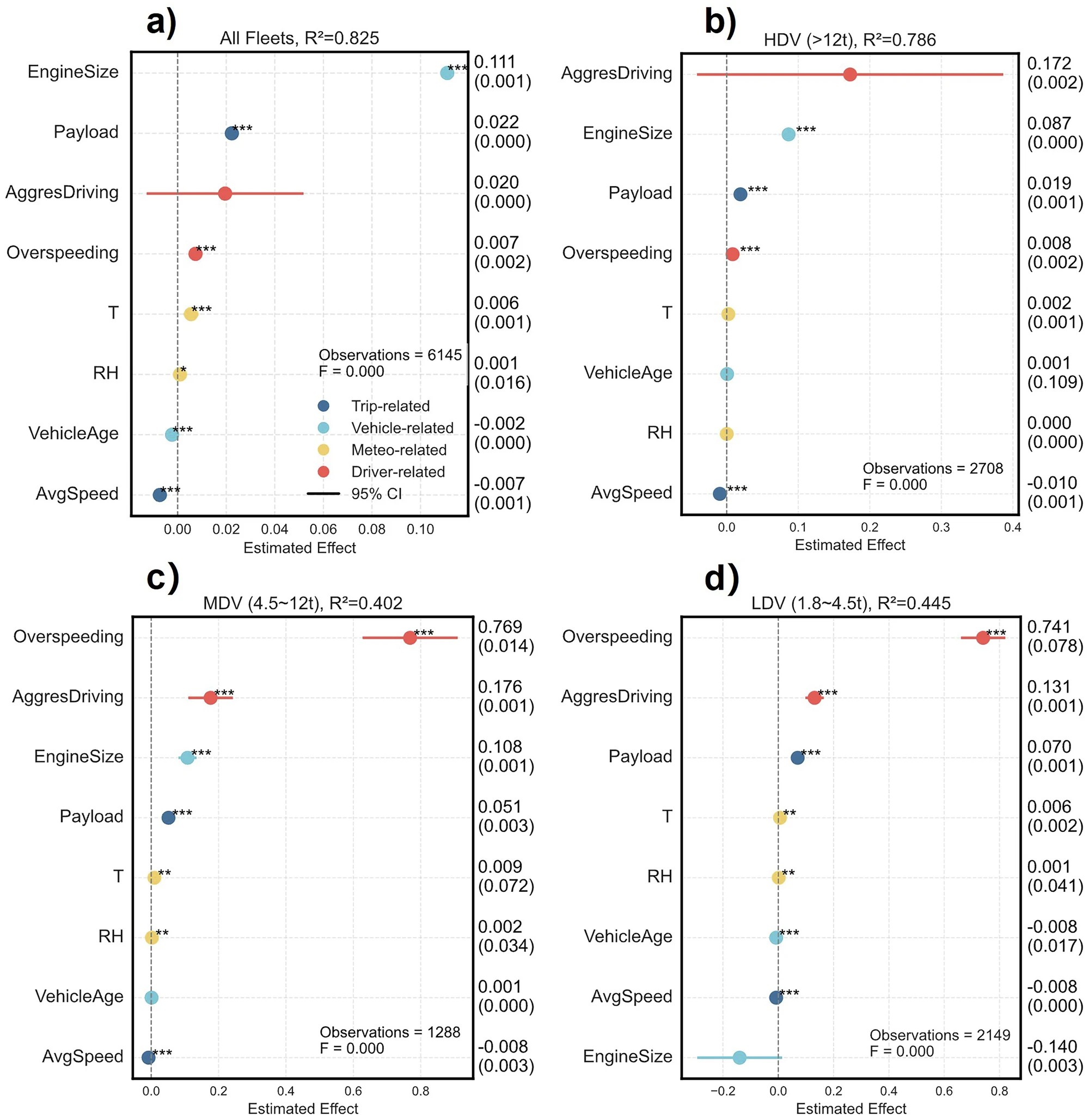
Figure 1. The importance and estimated effect of variables on average fuel consumption. (a) all fleets, (b) HDVs, (c) MDVs, and (d) LDVs. The estimated effect indicates the percentage change in average fuel consumption resulting from a one-unit change in the corresponding variable. Variables are shown on the left, with estimated effects and standard errors presented on the right. The statistical significance of the values that are displayed in the chart is indicated as follows: *p < 0.05, **p < 0.01, and ***p < 0.001
The study further developed a payload management evaluation framework based on real-world operating conditions, quantifying the economic and CO2 reduction benefits of two payload management strategies (i.e., maximum loading enforcement and empty-running optimization. The results showed that appropriate payload management could simultaneously deliver economic and carbon-reduction benefits (Fig. 2). On the one hand, although strict overloading control may increase transportation costs, these additional costs can be effectively offset by improving vehicle utilization efficiency. On the other hand, payload management can also significantly reduce CO2 emissions per unit of freight turnover, with net emission-reduction benefits ranging from 2 gCO2/tkm to 9 gCO2/tkm across different fleets. The study further noted that the economic benefits of payload management are more pronounced for heavy-duty trucks, whereas light-duty trucks may have relatively weaker incentives to voluntarily comply with payload regulations due to their persistently high overloading levels, thus requiring more targeted regulatory and incentive-based policies.
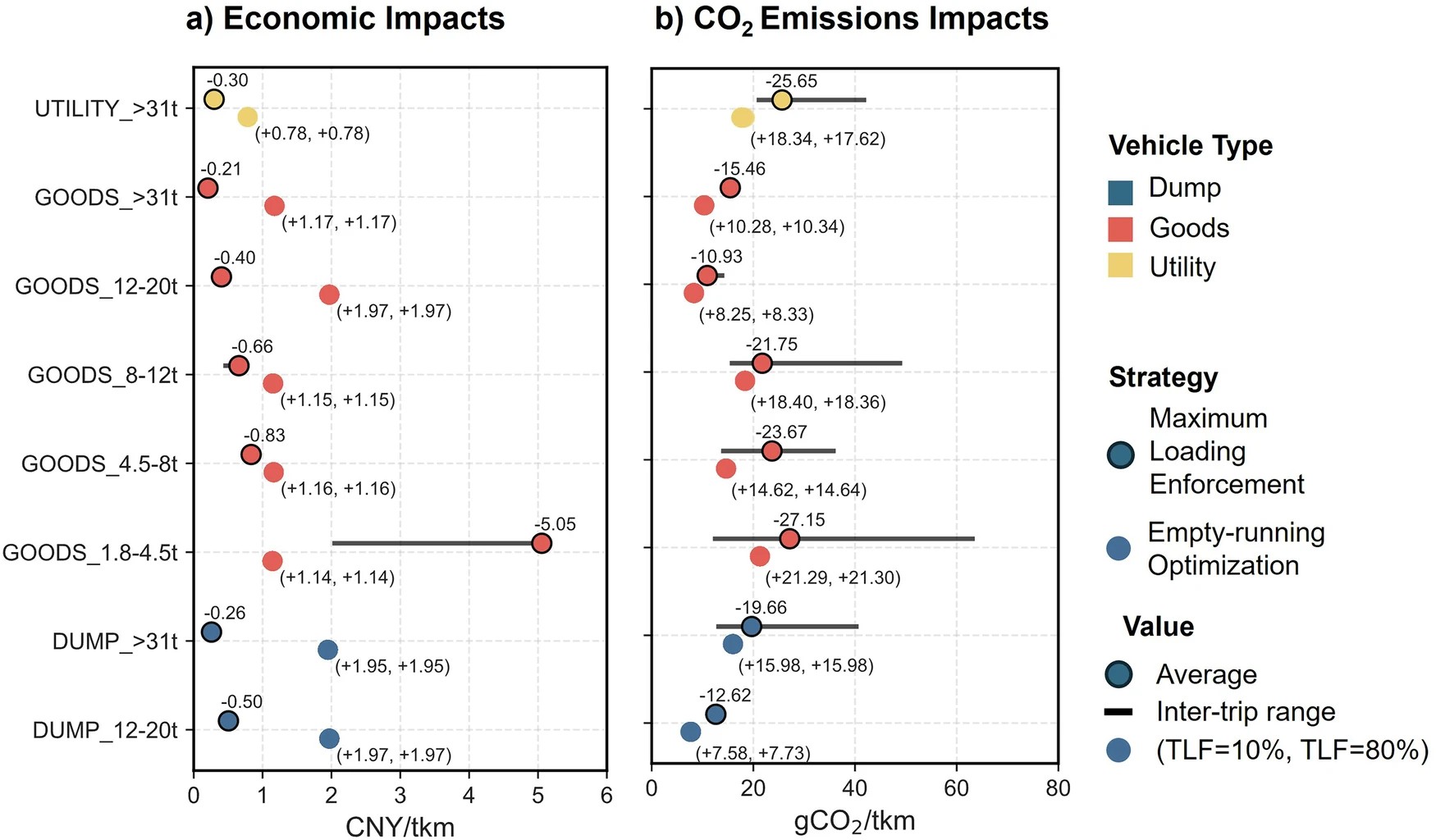
Figure 2. Impacts of truck payload management strategy on economy and CO2 emissions. a) Economic impacts of truck payload management strategies. b) CO2 emissions impacts of truck payload management strategies. The solid-outlined circle refers to the impacts from maximum loading enforcement, and the one without a solid outline is the effects from empty-running optimization. Parenthetical values indicate the estimated effects with TLF (targeted loading factor) varying from 10% to 80%. In a, positive values indicate economic profitability, while negative values represent costs. In b, positive values indicate increased CO2 emissions, whereas negative values indicate CO2 reductions.
The study suggests that future efforts should focus on developing intelligent freight transportation systems to reduce empty-running rates and improve the overall efficiency of road freight operations through goods–vehicle matching, capacity sharing, and transport coordination, thereby promoting the high-quality development of the road freight sector. Meanwhile, overloading supervision policies should gradually shift from the conventional “penalty-only” approach toward a framework that combines both “penalties and incentives,” encouraging freight operators to adopt safer, greener, and more efficient transportation practices.
On May 4, 2026, the study “Exploring the co-benefits of truck payload management on profitability and CO2 emissions” was published online in npj Sustainable Mobility and Transport. Li Hongyi (Ph.D. candidate at School of Environment, Tsinghua University) is the first author, and Dr. Wu Xiaomeng is the corresponding author. Co-authors include Prof. Wu Ye, Associate Prof. Zhang Shaojun, Lin Hao (Ph.D. candidate), and Ji Weijie (undergraduate student), all from the School of Environment at Tsinghua University.
This research was supported by the National Key R&D Program of China and the National Natural Science Foundation of China.
Links of Full Text:
https://www.nature.com/articles/s44333-026-00103-6


