From May 24 to 27, 2026, the 20th National Environmental Conference for Doctoral Students (NECDS) in Conjunction with 2026 AUA Postgraduate Academic Forum was successfully held in a hybrid format at the School of Environment, Tsinghua University. To promote the collaborative development of higher education in Asia and support young scholars in overcoming geographical barriers to engage in high-level academic dialogue, the program established a special scholarship with the AUA fund, supporting 7 outstanding doctoral students from AUA member universities to attend in person. Additionally, the forum attracted the active participation of many AUA students through online presentations and poster sessions, with 25 delivering online presentations and 11 presenting academic posters.
The 20th National Environmental Conference for Doctoral Students and the 2026 AUA Postgraduate Academic Forum featured seven thematic academic sessions: “Water Pollution Control and Resource Recovery,” “Solid Waste Pollution Control and Resource Recovery,” “Air Pollution and Control,” “Environmental Chemistry,” “Environmental Sustainable Systems and Dual-Carbon Management Strategies,” “Environmental Ecology and Global Climate Change,” and “Frontiers in Environmental Interdisciplinary Research and Dual-Carbon Technologies.” Graduate students from AUA member institutions fully demonstrated their innovative achievements in the fields of environment and sustainable development, showcasing the outstanding academic quality and cross-cultural collaborative potential of young Asian scholars.
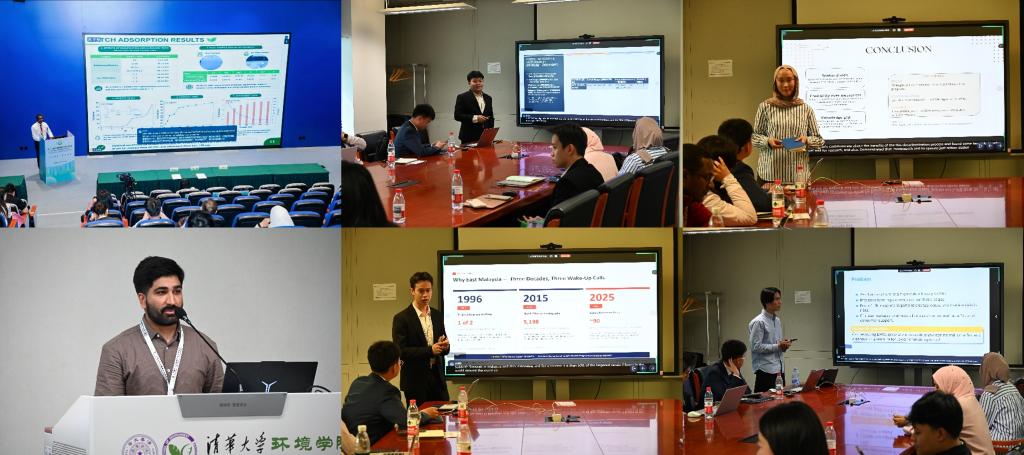
The conference highlighted several notable research achievements. Among them, Zaharaddeen Muhammad, a Nigerian doctoral student from Chulalongkorn University, received the forum's “Outstanding Oral Presentation” for his breakthrough in the green recovery of strategic metals and delivered a presentation at the closing ceremony. His research, entitled “Biochar-based curcumin-TOPO functionalized adsorbent for selective lithium recovery from brine”, innovatively utilized waste coconut shells to prepare biochar. Through the synergistic functionalization of curcumin and TOPO, he successfully developed an efficient, highly selective, and cost-effective lithium adsorption material, providing a new technological pathway for the sustainable supply of critical resources in the clean energy era.
Saniya Soltybayeva, a Kazakh doctoral student from Nazarbayev University, also received the forum's “Outstanding Oral Presentation”. Her research, “Who Supports the Energy Transition? Regional Attitudes and the Politics of Energy Reform in Kazakhstan” , focused on the social acceptance of energy transition as a core policy issue. Through an original survey of over a thousand residents across 19 cities in Kazakhstan, her study found that public support is closely linked to governance efficacy, job opportunities, and safeguards for social equity, with particularly evident resistance to transition in resource-dependent towns. She constructed an Energy Transition Attitude Index and a Just Transition Support Index, providing critical empirical evidence for the design of “just transition” policies.
Among the poster presentations, Abdul Malik, a Pakistani doctoral student from the University of Malaya, stood out as an outstanding poster. His research, “Assessing the biocontrol potential of Enterobacter asburiae isolated from paddy soil against Burkholderia glumae through in vitro and in silico studies,” focused on sustainable agriculture. He isolated a strain of Enterobacter asburiae from paddy soil capable of producing biosurfactants. Through molecular docking and dynamics simulations, he confirmed that its metabolites can stably bind to virulence factors of the pathogen, demonstrating significant potential for replacing chemical pesticides and promoting green agriculture.
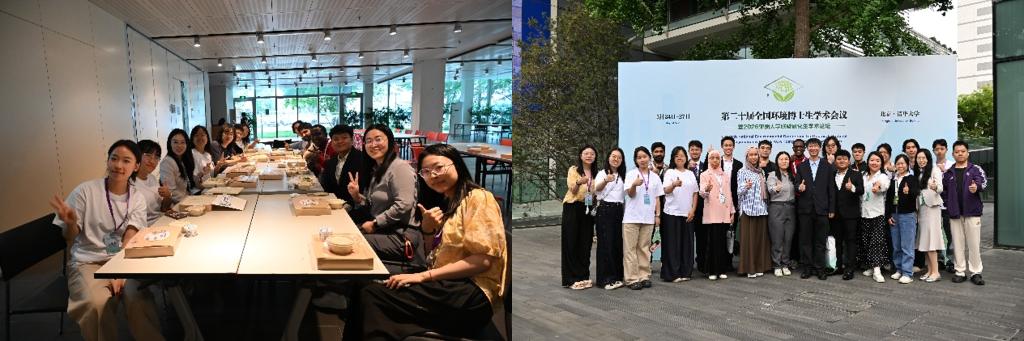
The conference has brought together young scholars from eight AUA member universities, including Tsinghua University, Peking University, the Hong Kong University of Science and Technology, the University of Tokyo, Nazarbayev University, the University of Malaya, Chulalongkorn University and the University of Yangon. Their presentations covered broad cutting-edge interdisciplinary fields such as novel cadmium-free photovoltaic materials, green biomass conversion, coastal ecological restoration governance, circular economy assessment, and sustainable consumer behavior. This fully demonstrated the outstanding academic quality, innovative vitality, and deep local engagement of young Asian scholars. From all participating doctoral students, the conference selected a total of 31 “Excellent Oral Presentation” recipients, 12 of whom were from AUA member universities, accounting for nearly 40% of the total. This highlights the significant effectiveness of the AUA platform in promoting high-level international academic exchange and cross-cultural dialogue.
The 20th National Environmental Conference for Doctoral Students and the 2026 AUA Graduate Academic Forum served as a profound intellectual exchange and cross-cultural dialogue. Although the participating young scholars come from diverse cultural backgrounds and focus on varying regional issues, their research shares a core theme: how to find feasible pathways for synergistic progress in environmental sustainability, social justice, and economic prosperity within their unique socio-economic contexts. Today, AUA is becoming an important cradle for nurturing a new generation of leaders to address regional and global challenges, continuously infusing the wisdom and vitality of young scholars across Asia into the building of a community with a shared future for humanity.


